
Learning Opera Singing - A Meditation on Unconditional Happiness

Led by my curiosity and a recommendation from my friend Henrik, I started reading Shinzen Young's book The Science of Enlightenment1 and began practicing meditation on a daily basis. At the same time, I also started private opera singing lessons, which, upon reflection, are two sides of the same coin with meditation. Together they pointed me to a possible path to find unconditional happiness in life.
"People's experience of life involves a sequence of moments of identification with self."
This is definitely how I felt when I restarted my training in opera singing recently. I have always loved singing since a young age, and I clearly identified myself as a good singer based on how I sounded (very modest 😁). Living in London, I had the privilege of enjoying world-class opera from Puccini to Verdi from my late 20s and fell in love with the art. Some say opera singing represents the top athletic level in singing, which appeals to the competitive side of me. I had attended a couple of group opera singing lessons, but never had personal opera singing vocal training. I felt the pull to really give it a go as I am starting my year of experiments and to see where it can take me.
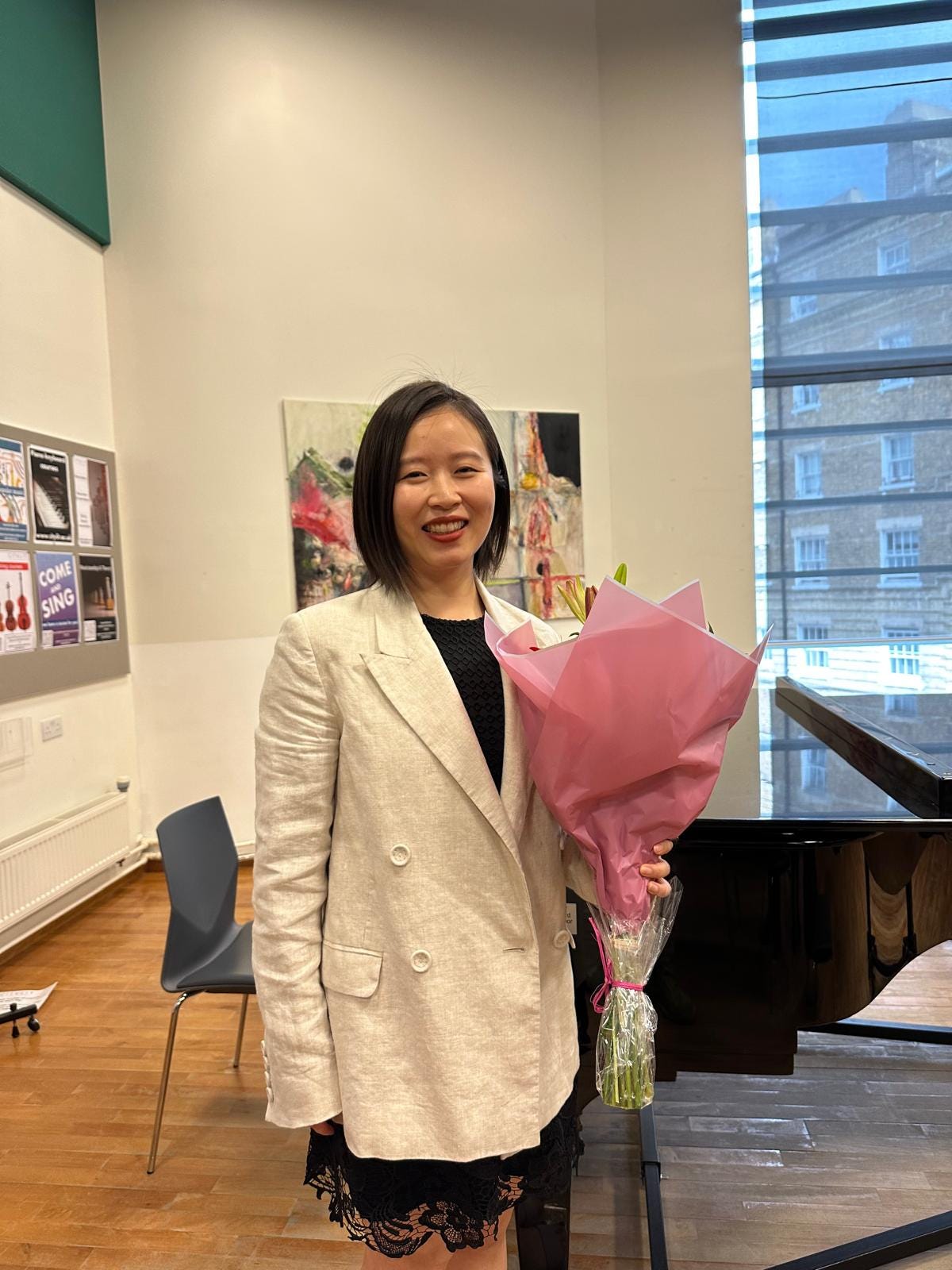
"Don't listen to how you sing." This was a key message I got from my tutor. Initially I was baffled—well, how can I not? Not to mention the practicality of it; I sing because I enjoy listening to how I sound. What's the pleasure in it if I don't listen to myself? It turns out that when I listen to how I sing, I start to adjust how I produce my voice vocally to fit a certain profile that I think sounds like an 'operatic voice,' whatever that means. Instead of focusing on foundational breathing and relaxation of the state, I started to have tension in my vocal cords, my body, and my voice resonance position got worse. All because I was relying on listening to my own voice as the only feedback mechanism and a real-time criterion of success. It also triggered my performance anxiety and led me to a vicious feedback cycle. The more focus placed on how I sounded, the more tension I got in my voice, and more strain I could hear from my own voice. It got particularly worse when high notes were approaching; it was like I was preparing for a battle for them to sound perfectly. When the high notes didn't sound great, I started to identify high notes as a constraint for me. My tutor suggested that I wear earplugs when practicing singing and use other senses to feel my own voice. Something interesting happened: when I couldn't hear my own projected voice (I could still hear it via the bone conductive part), I could feel more with my body—how the sound vibrated in my chest, how my breath traveled to my lower abdomen, even how the voice resonated in the back of my head. My vocal cords started to relax because I was no longer focusing on how I sounded, but concentrated on my entire body sensations. I started to sing more effortlessly as a result.
By focusing on only one of my senses, in this scenario, hearing, I was keeping identifying myself with the goal I achieved—how great I sounded, as that's the only outcome I associated with singing. I saw myself as a fixed "identity" or "thing," and I was collecting all the medals to decorate myself. Whereas when I started to reactivate all my body senses, I was allowing myself to interact with the environment fully and experience the experience of singing fully. In this way, rather than seeing myself as a fixed "thing," I experience the 'self' as a fluid process, where I have feedback from various perspectives when I start to interact with the environment and try different experiences. Rather than focusing on just one criterion and one perspective of the experience, I opened myself to the possibility of more depth. In other words, I was able to experience more elasticity of the "self."
I also experienced discomfort during opera lessons. Eager to improve my singing, I wanted my tutor to go straight to the point rather than elaborating in detail on tangential stories. Again, it is a result of me seeing my happiness as dependent on my achievement, in this case, becoming a better opera singer. I started to experience discomfort when my tutor started to explain fun facts about certain techniques. I started to feel annoyed and found my attention wandering from the story, while hearing an impatient voice in my head. Observing what I was doing, noticing my own pattern, I tried to relax my body and my breathing, relaxing the goal of wanting to dive straight into singing and performing. It relaxed me; I started to appreciate the background stories and genuinely enjoyed some funny stories. The extra context actually helped me overcome my problem with breathing. All the drills relaxed my voice, and when I started to practice the aria, I felt I naturally improved.
According to Shinzen, there are two ways to deal with discomfort. One is to enter the state of detachment, equanimity or balance, and pure experience accomplished by focusing on complete sensory experience; the other way is to figure out and seek comfort. This is interesting as my default way is definitely to seek comfort, which in modern society means finding a solution, usually achieved by spending money. Or running away, usually accompanied by other forms of entertainment or relaxation. But in this particular example, I was able to relax into my annoyance, feel it, observe it, hear my own annoyed inner voice and feel heat rising through my chest, but not identify with it or try to solve it. By allowing the sensations to happen and be experienced by me without too much resistance, I achieved a certain level of balance or, you could say, equanimity, which in turn helped me to embrace my own discomfort.
I am not sure if I can always find balance in discomfort, stop identifying myself with one fixed perspective of my own experience, or completely overcome my performance anxiety. I do believe there is a way to achieve unconditional happiness and live a richer life. Below are my thoughts.
Concentration state is inherently rewarding. When I focus on my sensory experience of singing and feeling voices with all my senses, my inner critic starts to quiet down; they are still there, but more like an undercurrent in the background. My mind starts to be calmer, and I start to treasure every note of the aria regardless of how I sound. Extending to the broader life, if I can be more focused in every moment of life, how many more facets and depth can I discover in every experience? "If you're consistently two or three times more focused in each moment of life, then you're living two or three times bigger, two or three times richer."2 Extending my life expectancy without any technology advancement? Sign me up!
I recently watched the movie "About Time" (mild spoiler alert), which is about time travel. There are a few secrets of living a good life shared in the movie. It mentioned the concept of living every day twice, and the second time to savour every bit of the moment, even the mundane part. But the ultimate secret is not to even relive the day, but living each day to the fullest. This to me is focusing on everyday experience with a balanced mind (not identifying with pain or pleasure, but observing them, fully experiencing them without agony or craving) and detailed noticing to achieve clarity. Having a balanced mind doesn't mean that I will tolerate objective conditions without wanting to change them—that is indifference. It means developing more acceptance toward my own sensory experiences. For example, I will talk to my tutor if I find certain perspectives of his teaching are not particularly helpful for me. At the same time, I will fully experience my own impatience and annoyance when it arises. If I can't control everything in life, then I may as well live with it with an open mind. Shinzen put it nicely here. "Pain that doesn't turn into bother ceases to drive us but continues to motivate us. In a similar way, pleasure that brings fulfilment ceases to drive us but continues to motivate." In this case, I will still want to improve how I work with my tutor by having an open conversation but not identifying with my own annoyance by observing it with an open mind.
Even pain, when experienced to the fullest moment, can be free of suffering and rewarding. I experimented recently in a cold plunge pool; it actually helped a lot, even briefly. I focused on my breathing and my body sensations. For a short while, I felt tingling sensations in my body, a very clear mind, with no panicking that I had experienced in previous cold plunge experiences without the meditative training. My nervous system actually calmed down; I felt relaxed yet alert after the cold plunge pool, which is exactly what Shinzen described the meditative state would feel like.
I also believe it is possible to transform the meditative experience of sitting in formal meditation practice into everyday life, just as I did in a cold plunge pool. To me, it is a core condition to achieve unconditional happiness. For most of us, we will not commit our lives to a monastery in the deep mountains and dedicate our lives to meditation. We need to work, make a living, have social connections, and perform tasks like washing dishes and hanging up laundry (not my favourite form of tasks). As Shinzen mentioned, "A delicious figure-ground reversal takes place. In the beginning, meditation is something that happens within your day. Eventually, the day becomes something that happens within your meditation." When I caught myself annoyed and bored while queuing, I started focusing on my body sensations and the nuances of the details that I felt moment to moment. I found that this not only took my boredom away but ignited my curiosity in mundane moments of life.
This essay represents more than an esoteric exploration of meditation—it records my attempt to integrate meditative awareness into daily life, seeking unconditional happiness whether I'm opera singing or washing dishes. It offers an honest examination of how I identify with experiences from moment to moment, often becoming trapped by rigid perspectives and losing sight of the fluid, processual nature of selfhood. I find it profoundly liberating to observe the observer itself, uncovering my own unconscious patterns. This practice reminds me to live with intention and to fully savor each moment as it unfolds.
I'm curious about your own journey: How do you cultivate unconditional happiness? What shapes your understanding of yourself? I'd love to continue this conversation with you—please share your thoughts in the comments below or reach out via email. Your insights would mean a great deal to me.
Thank you for being part of this exploration with me.
Shinzen Young, The Science of Enlightenment: How Meditation Works (Sounds True, 2016). Young blends neuroscience, traditional Buddhist practice, and his own decades of meditation teaching to present practical methods for cultivating clarity, equanimity, and compassion, aiming to bridge the gap between spiritual insight and scientific understanding.
Also from Shinzen’s book, The Science of Enlightenment: How Meditation Works
This really resonated, Jennifer. I’ve been thinking a lot about sitting with discomfort and wrote about Hot & Cold therapy recently. I did another class this weekend and sitting in the cold plunge pool, breathing through the discomfort taught me that acceptance and surrendering my mind and body to the feeling actually helped me get through it more easily than fighting it. I also felt so much better for having done it (vs immediately getting out the water and seeking comfort) x