
Okapi and critical thinking in the age of AI

Sitting at our favourite local café, waiting for delicious coffee and brunch, my attention drifted to a book on the corner shelf. The cover featured a zebra-like animal that also had features of a giraffe, horse, and deer. The title read "What you can see from here."
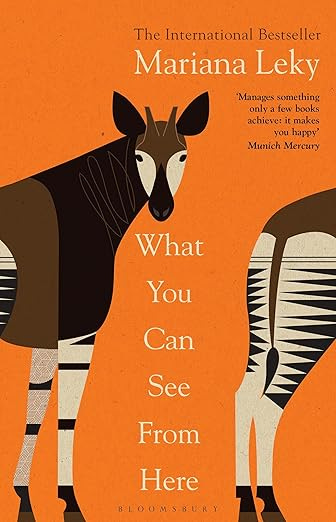
"Ah, I know what this is about," I thought aloud. "It's a pop science book about how we perceive the world, and this is a fictional animal created by combining multiple animals." I had seen similar perception tests many times—images that can be interpreted in different ways, like two profile faces or a vase, depending on your perspective.
Satisfied with my clever observation, I shared my discovery with my partner. To my surprise, he strongly disagreed, insisting it was a real animal, not a fictional one. He believed the book was a travel guide, probably about somewhere in Africa. Confident in my perception and common sense, I decided to reverse search the image. It turned out he was partially right—the animal is called an okapi. It really exists! And the book was a novel set in Central Africa, neither a pop science book nor a travel guide.
How could I be so wrong yet so confident in my assumptions? My partner thinks it's because he has extensive experience reading English books and recognises different cover design patterns. I felt the same way—I've read plenty of English books and am particularly familiar with pop science psychology tests that examine perception. We can speak the same language, yet interpret meanings completely differently.
This led me to think about how making meaning is almost second nature to humans. We rely on meanings to thrive, drive, interact socially, and build relationships. However, I rarely challenge how I interpret those meanings or perceive the world. Layers of assumptions build upon chains of thought—some explicit, some implicit. This contemplation inspired the following reflections I'd like to share with you.
Context matters and context is personal - Challenge how common is my common sense?
I am constantly influenced by my personal context, environment, and culture. Some context has traveled across generations, some I've recently absorbed, and some emerges continuously from new interactions. If I think of everyone's context as a circle, we're constantly moving Venn diagrams. When we overlap, we create new colours of understanding. That happens when we're open to connection and willing to challenge our common sense, resulting in new understanding for both parties. But if I close myself off, too confident in my own common sense and unwilling to be challenged or fact-checked, how many opportunities for correction and creation will I miss?
Intuition can hinder challenge of assumptions
I've always been intuitive, learning new things quickly. I trusted my intuition because it was effective. But over-reliance on intuition can prevent us from challenging assumptions, sometimes risking life in narratives that sound reasonable but actually deviate from reality.
How do I know my blind spot?
What about the hidden assumptions I make without awareness? How can I identify my own blind spots? How do these hidden assumptions affect my everyday life without my realising it? The word "mirror" comes to mind—mirrors held by trusted others, mirrors found in observing everyday life, reinforcing the feedback loop. Looking in mirrors can induce anxiety, second-guessing, and self-doubt when the reflection connects to my identity and true core. I've noticed energy rising sometimes when challenged. Upon reflection, this often relates to my pride. Noticing without dwelling or over-interpreting, establishing a foreground balance—this connects closely to mindfulness practice and might be an area worth exploring deeply.
How do I remain a critical thinker in the age of AI?
I feel some resistance bringing up AI, knowing you've probably seen, read, and heard enough about it. There's an overwhelming amount of information about AI, much of it produced by AI itself. This sense of annoyance I feel is precisely why I need to face it. How do I fact-check and distinguish AI-produced content while remaining a critical thinker? I want to examine this question from the perspectives of AI interpretability, human thinking processes, and everyday AI tool usage.
Interpretability of AI
Eric Ho defined interpretability1 as "Understanding and controlling how models represent and compute concepts." He frames it not just as "peeking inside" models, but as developing the ability to decode internal representations, trace computations, and intentionally modify them—so we can both explain and engineer model behaviour. In this essay, I am focusing on understanding the explicit chain of thought reasoning by the model, the internal thinking process, what mechanisms or representations inside the model led to the output. Despite the fact that a lot of the models now can output their chain of thoughts as part of the output production process, however, their real chain of thoughts are often kept hidden and very much influenced by rewards, hacks and shortcuts2.
Chain of Thoughts in human thinking
Human thinking is also complex—we too have internal thinking processes and surface reasoning processes. These often mix with intuition, which can't always be logically explained. I recognise patterns in my own reverse engineering process: I want to believe certain things, so I try to justify them. Behind confirmation bias lies a desire to believe, and these emotional needs are difficult to confront.I've also noticed that while connecting different points and building internal connections, many implicit assumptions go unnoticed until written down. Without documenting them, I can't properly analyse, evaluate, or critique them. As mentioned earlier, challenging deeply-held beliefs can be painful, as they often connect with our identity and carry emotional weight.
Tips for everyday AI tool usage to support critical thinking
As an everyday AI tool user and content consumer rather than a researcher, how can we fact-check AI reasoning and better understand interpretability?
Ask for structured reasoning: prompts such as "List your assumptions before answering." can be extremely helpful
Use self-critique prompts: "Now, critique your own reasoning as if you were skeptical of it." Experiments like this can be a window for us to peek inside their reasoning.
Chain-of-thoughts verification: Run the same problem twice, once asking for reasoning, once asking only for the answer, and compare.
Use different AI models and compare the different results: I used both Claude and ChatGPT for my UK tax related questions, under my specific use case, they actually gave completely different answers.
Checking for the source references: spend time to read the source documents can be really helpful, especially to understand the assumptions incorporated into those source documents. More importantly, a daily reminder so that I don't forget how to read and summarise on my own without the help of AI.
I don't know exactly how I went from discovering the amazing okapi to discussing AI interpretability and critical thinking. Perhaps this is the point of this essay—if I don't write down and closely examine my thoughts, they remain unquestioned, frozen in space. By being open to documenting them, I give myself the chance to examine them in the present moment and in the future, both by myself and with others.
Thanks for reading and following along! Looking forward to hearing your thoughts.
https://www.anthropic.com/research/reasoning-models-dont-say-think
https://www.goodfire.ai/blog/on-optimism-for-interpretability